My extensive experience in academia is a testament to my deep expertise and unwavering commitment to education and research. With a proven track record of delivering exceptional outcomes, I am a seasoned academician who excels in bridging theory with practical application.
I excel in my academic work with a strong sense of autonomy, making me a self-reliant and efficient educator and researcher. My ability to take initiative and drive projects forward independently has consistently proven to be a valuable asset in advancing educational and research outcomes.
I immerse myself in every facet of the academic journey, cultivating collaboration and synergy across disciplines. My commitment to active participation ensures that I contribute meaningfully to research and education, driving innovation and excellence.
I actively engage with the broader community, bridging the gap between academia and the public. My involvement in outreach initiatives ensures that the knowledge we generate has a positive impact on society and fosters a greater understanding of our work.
The Ontario Center of Innovation (OCI) is funding a groundbreaking collaboration between Elocity Technologies Inc. (“Elocity”), an Ontario-based EV charging technology company, and a researcher at Wilfrid Laurier University, to develop HIEV-AI, an intelligent planning and return-on-investment (ROI) estimation platform for EV charging infrastructure in multi-unit residential buildings (MURBs). HIEV-AI is designed to accelerate decision-making for MURBs and improve charging accessibility and availability for unit owners and drivers.
As EV adoption accelerates, MURBs face unique challenges in planning and financing EV charging infrastructure. The HIEV-AI platform will use advanced artificial intelligence to help property developers, utilities, and municipalities make faster, data-driven investment decisions – cutting costs and deployment time while ensuring equitable charging access for residents.
“Ontario is leading the EV revolution, and this project will give property owners and operators the tools to plan smarter and invest better,” said Sanjeev Singh, CEO of Elocity. “By combining our real-world experience in large-scale EV charging deployments with Laurier’s AI expertise, we’re creating a solution that helps communities transition to clean mobility faster and more efficiently.”
Led by Dr. Sukhjit Singh Sehra, Assistant Professor in Laurier’s Faculty of Science, the research will focus on developing machine-learning models to optimize charger placement, predict demand, and estimate financial returns. The two-year project will also test the technology at pilot sites across Ontario, integrating real-time analytics, load management, and renewable energy compatibility.
“This collaboration takes applied research out of the lab and into the field,” said Dr. Sukhjit Singh Sehra. “By pairing AI and data analytics with Elocity’s deployment experience, we’re building a predictive framework for smarter EV infrastructure planning – making it more strategic, cost-effective, and sustainable as Ontario accelerates toward cleaner mobility.”
HIEV-AI shifts EV infrastructure deployment from reactive to proactive, giving cities, developers, and utilities a clear view of capacity needs and costs so they can plan, build, and operate in line with sustainability and policy mandates.
Elocity Technologies Inc. is a Canadian-born global EV charging technology company headquartered in Toronto. Operating in 12 countries across four continents, Elocity delivers end-to-end EV charging solutions for multi-residential and commercial buildings, public charging networks, workplaces, and utilities. As the first Canadian company to achieve full OCPP (Open Charge Point Protocol) certification from the Open Charge Alliance (OCA), Elocity’s platform ensures no vendor lock-in and is fully future-proof. Elocity provides smart charging hardware and intelligent software engineered for reliable, cost-effective, and scalable deployments, integrating more than 50 charger models and supporting nearly every EV sold across North America and other major markets. Elocity’s made-in-Canada innovation continues to set new benchmarks in the EV industry – highlighted by the installation of more than 1,200 chargers at Richmond Centre in Richmond, B.C., recognized as a 2026 Top Project by Canada’s Clean50.
Wilfrid Laurier University is committed to academic excellence. Laurier’s holistic approach to learning integrates innovative programming with hands-on experience outside the classroom to ensure Laurier graduates are not only ready for the future but are inspired to leave their mark on the world. Community is at the heart of everything the university does. Laurier inspires students to engage in campus life and the broader community, leading to high levels of student satisfaction and engaged alumni who carry the Laurier legacy throughout the world. As a community of researchers, leaders and educators, Laurier builds knowledge that serves society and creates connections that have a lasting impact. Learn more about Laurier’s 20,000+ students in Waterloo, Brantford, Kitchener, Milton and Toronto at wlu.ca.
HIEV-AI is an AI-powered planning and return-on-investment (ROI) estimation platform for EV charging infrastructure in multi-unit residential buildings (MURBs), developed through a collaboration between Elocity Technologies Inc. and Wilfrid Laurier University.
The Ontario Centre of Innovation (OCI) is funding the project.
The research is led by Dr. Sukhjit Singh Sehra, Assistant Professor in Wilfrid Laurier University’s Faculty of Science, in partnership with Elocity Technologies Inc.
The project runs for two years and includes testing the technology at pilot sites across Ontario.
Multi-unit residential buildings face unique challenges in financing and planning EV charging infrastructure. HIEV-AI uses machine learning to help property developers, utilities, and municipalities forecast demand, optimize charger placement, and estimate costs more accurately.
This is a comprehensive summary of the Vision-Language Navigation (VLN) system and project demonstrated in the provided material.
Project Title: VLN Project – Grounding Language in Visual Environments Project Domain: Robotic Embodiment and Human-Robot Interaction (HRI)
Our Vision-Language Navigation (VLN) project is developing an advanced, integrated model that allows an autonomous mobile robot to understand, interpret, and execute complex, multi-step natural language instructions within dynamic indoor environments. We are bridging the gap between natural language understanding and robotic perception by enabling the robot to "ground" linguistic concepts—such as specific object names and spatial directions—into real-world visual features and actionable navigation maps.
The "model" we are developing is a comprehensive robotic agent pipeline rather than a single neural network. It functions as a closed-loop system with three primary stages:
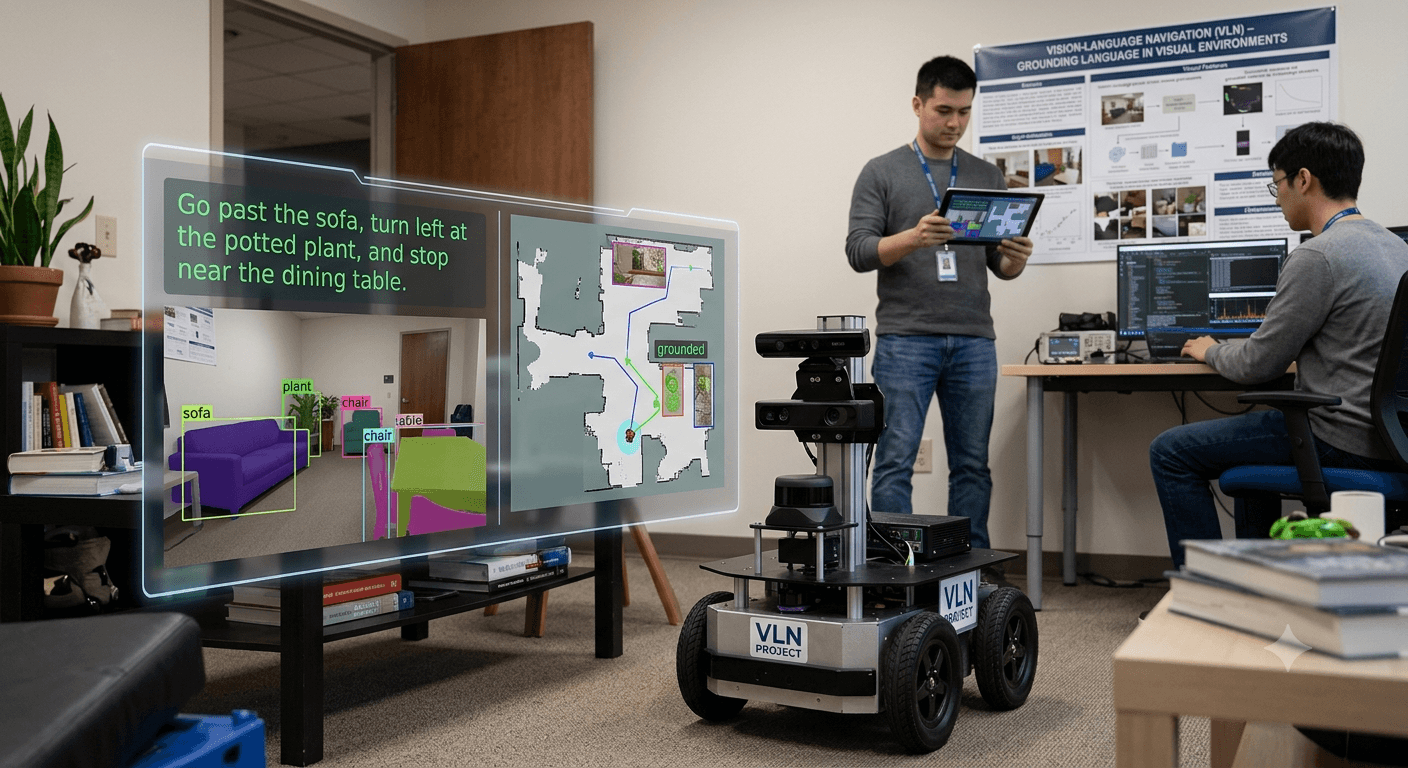
Instruction Interpretation (Language Model): The system receives natural language instructions (e.g., "Go past the sofa, turn left at the potted plant..."). The language model parses this sequence, identifying objects (referents), spatial prepositions, and action sequences.
Visual Perception & Object Detection (Vision Model): A depth camera array mounted on the mobile robot processes the live environment view. Our computer vision model segments the scene and detects specific objects (bounding boxes and masks shown for "sofa," "plant," and "chair"), aligning these visual assets with the vocabulary parsed in the previous step.
Semantic Grounding & Path Planning: This is the critical integration step. The system visually grounds the instruction by mapping the recognized objects ("sofa," "plant") onto a live 2D environment map. The navigation planner generates a dynamic, executable path (the blue path shown on the map) that satisfies the spatial and logical constraints of the instruction, guiding the robot to the correct destination.
Embodied Grounding: The key focus is moving beyond passive object recognition to "embodied grounding." The model doesn't just recognize a "chair"; it understands that a "chair" is a specific navigational waypoint referenced in its instruction.
Real-Time 2D Mapping (SLAM): The robot builds and updates a precise occupancy grid (2D map) of its surroundings using Simultaneous Localization and Mapping (SLAM). This allows it to plan a path while grounding objects within a known global context.
Integrated Multi-Sensor Suite: The mobile robot platform (VLN Project robot) utilizes synchronized data from visual cameras (for semantic classification) and a LiDAR sensor (typically hidden in the lower chassis for structural mapping), providing a robust multi-modal perception model.
The Robot Agent: A mobile robotic platform with a synchronized camera array and localization sensors.
Augmented Reality (AR) Interface: A futuristic AR visualization tool used for monitoring the robot's internal process, showing object detection, live mapping, and the explicit grounding connection.
Human Interface: A tablet controller and a workstation for programming and monitoring research (as seen being used by the researchers).
The ultimate goal of this research is to create robust, generalized robotic agents that can operate seamlessly in human environments, taking open-ended commands and navigating to unknown locations by referencing the objects and landmarks within their visual context
Based on your query, it appears you are referring to the DTUMOS (Digital Twin for Urban Mobility Operating System) project. Here is a comprehensive summary of the framework based on the available research data:
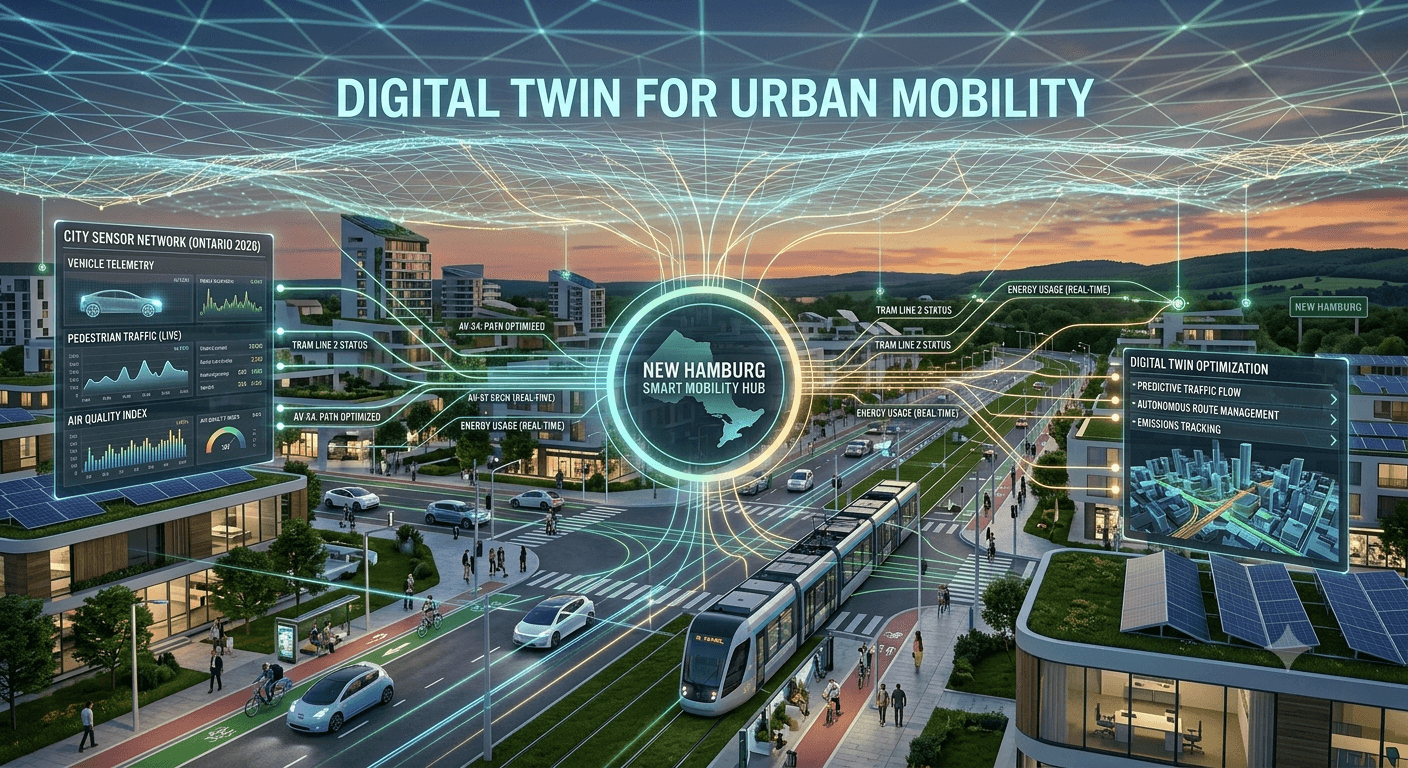
DTUMOS is a versatile, open-source digital twin framework designed specifically for large-scale urban mobility operating systems. Rather than solely monitoring existing infrastructure in real time, DTUMOS serves as a virtual test bed and playground. Within this virtual environment, urban planners and researchers can develop, test, and adapt various mobility systems, operation algorithms, and urban policies.
The framework is built around a novel architecture that strategically combines an AI-based estimated time of arrival (ETA) model with a vehicle routing algorithm. This design enables DTUMOS to achieve high-speed performance while maintaining accuracy across large-scale mobility implementations. The system operates through a structured, four-part pipeline:
Data: The framework uses real-world data as a foundational element to accurately represent the physical world. This data includes the usage patterns of passengers and goods, capturing specific boarding and disembarkment times and locations. It also considers the spatial and temporal characteristics of travel, such as traffic congestion and peak hours.
AI and Machine Learning Models: The system proposes a novel framework to correct the locations and travel times of vehicles.
Mobility System Operation: The platform allows users to flexibly modify the dataset, the type of mobility system, and the specific operation algorithms and strategies being tested. Users can develop and experiment with various algorithms, including ride-sharing, advanced dispatch, dynamic pricing, and vehicle re-balancing.
Outputs: Upon completion of a virtual simulation, DTUMOS generates comprehensive simulation visualizations alongside quantitative performance reports.
DTUMOS distinguishes itself from existing state-of-the-art mobility digital twins by demonstrating distinct advantages in three primary areas:
Scalability: The framework's scalability has been heavily expanded and rigorously verified through implementations in major metropolitan areas, including Seoul, Chicago, and New York City. It is capable of modeling large mobility networks encompassing more than 30,000 vehicles and 200,000 passengers.
Speed and Iteration: The system's open-source and lightweight environment makes it highly advantageous for processes requiring iterative learning, such as reinforcement learning.
Visualization: It delivers flexible, high-performance visualization capabilities that are currently impossible to achieve with other existing mobility digital twin platforms.
Ultimately, DTUMOS provides decision-makers with the ability to experiment with various policies and algorithms in a safe, virtual setting. This testing capability allows for the design of transparent and equitable policies that benefit all mobility stakeholders, including platform providers, users, and drivers. Furthermore, the project aids in evaluating emerging concepts like Mobility-as-a-Service (MaaS) and supports the evolution toward Digital-twin-as-a-service (DTaaS) models.
The future of electric vehicles (EVs) looks bright, as more and more consumers are choosing to switch to electric power and governments and businesses are investing in the development of charging infrastructure.
One potential area of growth for EVs is in the development of autonomous vehicles, which are vehicles that are able to operate without the need for a human driver. Autonomous EVs have the potential to significantly improve safety and efficiency on the roads, and they are already starting to be tested in a variety of settings.
Another potential area of growth for EVs is in the development of new battery technologies. Current EV batteries have a limited range and can be expensive, which can be a barrier for some potential buyers. However, researchers are working on developing new battery technologies that are more energy-dense, longer-lasting, and more affordable, which could make EVs more appealing to a wider range of consumers.
Additionally, the growth of EVs is likely to be supported by an expansion of the charging infrastructure. As more and more EVs are sold, the demand for charging stations will increase, which will drive the development of new charging technologies and the expansion of the existing charging network.
Overall, the future of EVs looks bright, as new technologies and innovations continue to emerge and more consumers and businesses recognize the benefits of electric power.
Blockchain technology is a decentralized and distributed ledger system that has gained widespread attention for its potential to revolutionize various industries. Unlike traditional centralized databases, blockchain stores data in a tamper-resistant, chronological chain of blocks. In this discussion, we will explore the fundamental concepts of blockchain, its applications beyond cryptocurrencies, and some of the challenges it faces.
At its core, a blockchain is a chain of blocks, each containing a batch of transactions. These blocks are linked together using cryptographic hashes, ensuring the integrity of the data. Once a block is added to the chain, it becomes virtually immutable, making it highly secure against tampering. Blockchains can be public, allowing anyone to participate, or private, with restricted access. Key features include decentralization, transparency, and consensus mechanisms like Proof of Work (PoW) or Proof of Stake (PoS).
While blockchain's initial application was in cryptocurrencies like Bitcoin, its potential extends far beyond digital money. It is increasingly used in various sectors such as supply chain management, where it enhances transparency and traceability. Blockchain also finds applications in identity verification, enabling individuals to have control over their personal information. Smart contracts, self-executing agreements with predefined rules, automate processes in fields like legal and finance. Moreover, blockchain can facilitate voting systems, reducing fraud and increasing trust in elections.
Despite its promise, blockchain faces several challenges. Scalability is a significant concern, as increasing the number of transactions can slow down networks and raise costs. Energy consumption, especially in PoW-based blockchains, has drawn criticism for its environmental impact. Regulatory and legal issues also pose challenges, as governments grapple with how to regulate this technology. Additionally, blockchain is still evolving, and standards for interoperability and security need further development.
Blockchain technology is still in its early stages, but its potential to disrupt industries is evident. As scalability and energy efficiency improve, and regulatory frameworks mature, blockchain adoption is likely to grow. Interoperable blockchain networks could enable seamless data sharing, and advancements in consensus mechanisms could enhance efficiency and security. In the future, blockchain may become an integral part of various sectors, transforming how data is stored, shared, and verified.
In conclusion, blockchain technology has emerged as a powerful innovation with the potential to reshape industries beyond cryptocurrencies. Its fundamental principles of decentralization and transparency offer solutions to long-standing challenges in data management and trust. While challenges persist, ongoing research and development efforts are paving the way for blockchain's integration into diverse applications, making it a technology to watch in the coming years.
Quantum Computing is a cutting-edge field that explores the use of quantum-mechanical phenomena to perform computations. Unlike classical computers that use bits as the fundamental unit of information, quantum computers use quantum bits or qubits, which can exist in multiple states simultaneously due to the principles of superposition and entanglement. In this discussion, we will explore the fundamentals of quantum computing, its potential applications, and some of the challenges it faces.
Quantum Computing Fundamentals:
Quantum computers leverage the unique properties of qubits to perform calculations at a scale that classical computers cannot achieve. Superposition allows qubits to represent both 0 and 1 simultaneously, and entanglement enables the state of one qubit to be dependent on the state of another, even if they are physically separated. Quantum gates manipulate these qubits to perform operations, and quantum algorithms harness these properties for solving specific problems more efficiently.
Potential Applications:
Quantum computing holds immense promise in various domains, including cryptography, optimization, drug discovery, and materials science. One notable application is in breaking current encryption methods, which could have both positive and negative implications for cybersecurity. Quantum computers can also revolutionize supply chain optimization, simulate quantum systems accurately, and discover new materials with extraordinary properties. These applications have the potential to reshape industries and scientific research.
Challenges in Quantum Computing:
Despite its potential, quantum computing faces several significant challenges. One key challenge is maintaining the stability of qubits. Qubits are highly susceptible to environmental factors like temperature and electromagnetic radiation, making error correction a daunting task. Developing error-correcting codes and stable qubit technologies is crucial for practical quantum computing. Moreover, building scalable quantum hardware remains a considerable engineering challenge, with quantum computers today being in their infancy.
Quantum Computing and the Future:
The growth of quantum computing is inevitable, and its impact on various industries will be profound. Organizations and researchers are racing to develop quantum hardware, algorithms, and applications. Quantum supremacy, the point at which quantum computers surpass classical computers in specific tasks, is an exciting milestone on this journey. As quantum technologies mature, we can anticipate transformative breakthroughs in cryptography, optimization, and scientific discovery, ushering in a new era of computing and problem-solving.
In conclusion, quantum computing represents a revolutionary shift in the world of computation. Its unique properties and potential applications make it a highly promising field, although it is still in the early stages of development. Overcoming the challenges associated with quantum computing will be essential for realizing its full potential and reshaping various industries in the years to come.
DevOps and Continuous Integration/Continuous Deployment (CI/CD) are two closely related practices that have revolutionized software development and deployment processes in recent years. They represent a paradigm shift in how software is built, tested, and delivered, enabling organizations to achieve faster release cycles, higher quality software, and improved collaboration between development and operations teams. In this discussion, we will delve into the core principles and benefits of DevOps and CI/CD, their role in modern software development, and some best practices for implementing them effectively.
DevOps is a cultural and technical approach that emphasizes collaboration, communication, and integration between software development (Dev) and IT operations (Ops) teams. It aims to automate and streamline the entire software development lifecycle, from code development to production deployment. DevOps encourages a shared responsibility for the entire process, breaking down silos that often exist between these traditionally separate teams. Key principles include automation, continuous monitoring, and a focus on delivering value to the end-users.
Continuous Integration (CI) is a crucial component of DevOps. It involves the practice of frequently integrating code changes into a shared repository, where automated tests are run to ensure that new code does not introduce defects or break existing functionality. CI helps catch and fix issues early in the development process, reducing the likelihood of integration problems later on. It promotes a culture of frequent, small code changes and collaboration among developers.
Continuous Deployment (CD) takes CI a step further by automating the deployment process to production or staging environments after successful integration and testing. This means that every code change that passes CI tests is automatically deployed, reducing manual intervention and minimizing the time between writing code and delivering it to users. CD allows organizations to release new features and bug fixes rapidly, improving user satisfaction and competitive advantage.
The adoption of DevOps and CI/CD offers numerous benefits to organizations. These include faster time-to-market, increased software quality and reliability, reduced manual errors, improved collaboration among teams, and the ability to respond quickly to changing market demands. Additionally, DevOps and CI/CD provide greater visibility into the development and deployment process, enabling better tracking and management of software projects.
DevOps and CI/CD are transformative practices that have become essential in the software development landscape. They enable organizations to build, test, and deploy software more efficiently, with higher quality and faster release cycles. By fostering collaboration between development and operations teams and automating key processes, DevOps and CI/CD help organizations stay competitive in a rapidly evolving digital world. Embracing these practices is not only a technological choice but also a cultural shift that can drive innovation and business success.
The user interface (UI) and user experience (UX) in car infotainment systems are essential for providing a seamless and enjoyable experience for drivers and passengers. Here are some key considerations for designing a great UI/UX in car infotainment:
By focusing on these key considerations, designers can create an intuitive and enjoyable UI/UX for car infotainment systems that enhance the driving experience and keep users engaged and safe on the road.